

For years, the conversation around Australia's industrial decarbonisation has centred on ambition: who has set a target, how aggressive it is, and whether it's credible. That conversation is largely over. Most major organisations now have targets. Frameworks like the Safeguard Mechanism and the Australian Sustainability Reporting Standards (ASRS) have given industry a shared language for accountability, and boards no longer need convincing that the transition is coming. The destination is not in serious dispute.
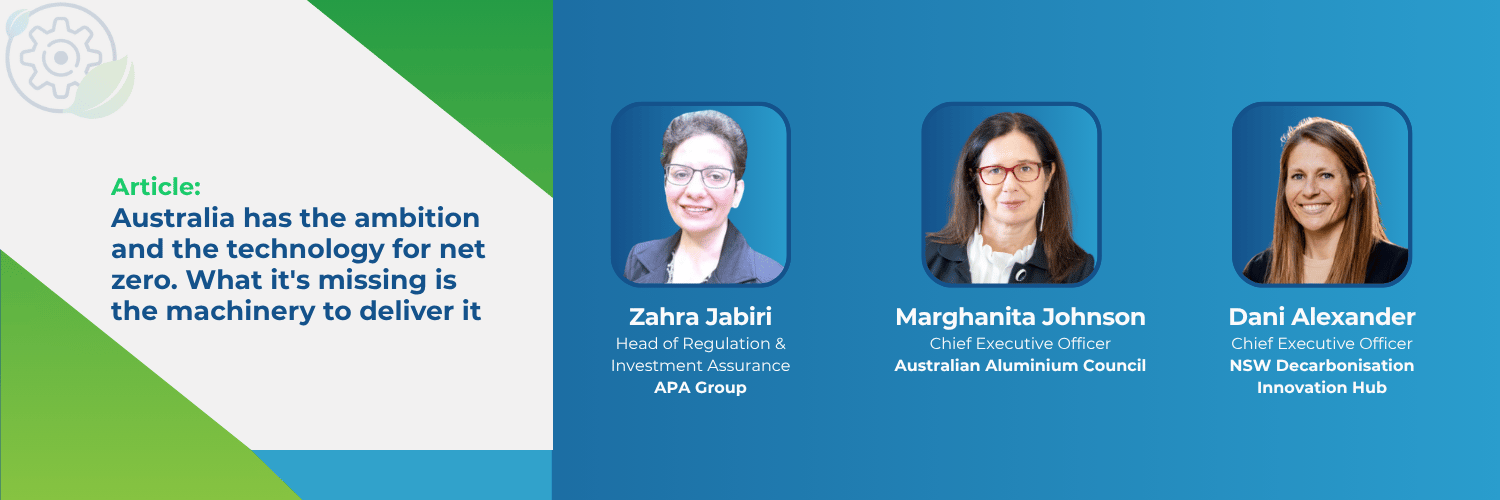
What's emerging instead, from three very different vantage points across the energy and industrial landscape, is a more uncomfortable question: if everyone agrees on where we're going, why isn't it happening faster? The answer, it turns out, doesn't sit in any one place. It sits in the gaps between capital, policy and deployment, the connective tissue that determines whether a well-intentioned target ever becomes a built asset. Three people working in very different corners of the system were asked, separately, what's really standing in the way. Their answers, read together, tell a more coherent story than any one of them tells alone.
From ambition to investability
Zahra Jabiri, who works across regulation, investment and reliability in the power industry at APA, puts it more bluntly than most. "We've moved from an ambition challenge to an investability challenge," she says.
It's a small phrase carrying a large diagnosis. According to Jabiri, the barrier holding back Australia's net zero transition is rarely the technology itself. "A lot of projects aren't stuck because the technology doesn't work," she explains. "They're stuck because the commercial case isn't yet strong enough for investors and lenders."
The conditions underpinning that commercial case have shifted substantially in a short time. "Capital is more expensive, construction costs are higher, supply chains are still challenging in some areas, and there's uncertainty around where future demand will come from for some low-carbon products," Jabiri says. Even well-capitalised companies that set ambitious targets a few years ago are now navigating a materially different investment landscape, which is part of why some organisations have recently revisited the timelines attached to their original commitments. "The destination hasn't changed," Jabiri notes, "but the economics of getting there have become a lot tougher."
If the technology isn't the constraint, what is? For Jabiri, it comes down to one word: certainty. Not certainty about whether a technology will work, but certainty about what happens commercially once it does. "Most investors can live with technology risk or delivery risk if they believe there's a market at the other end," she says. "What's harder is making a billion-dollar investment when you're not sure what the demand will look like in 10 years, what the carbon price might be, or whether customers will actually pay a premium for lower-emissions products."
Her proposed fix is not bigger subsidies but better-designed risk-sharing, mechanisms like Contracts for Difference that narrow the gap between what the market supports today and where policy wants it to land in future. "The reality is that investors don't always need a huge subsidy," she says. "They need confidence." As she sums it up: "the bankability gap is really a confidence gap."
What bespoke deals actually signal
That framing sheds useful light on a question that's been circulating since government support for the Tomago aluminium smelter was announced: is this kind of intervention a one-off, or a sign of things to come?
Marghanita Johnson of the Australian Aluminium Council is careful not to comment on the specifics of a deal she wasn't party to. But her broader observation is telling: Rio Tinto's Boyne smelter secured its own bespoke arrangement earlier this year, and in her words, "smelters always need bespoke deals." Tomago, in other words, isn't an anomaly; it's consistent with a pattern the sector has seen before.
The Australian Aluminium Council has been building the case for what that pattern should lead to. Its research this year on energy policy reform argues that getting the settings right for aluminium doesn't just help one sector: it creates what Johnson describes as an "immediately replicable architecture" for the broader range of energy-intensive industries Australia needs to retain and grow. A separate paper from the Council, released last year, looked at how smelters can navigate increasingly interventionist policy settings while remaining competitive against international rivals.
Jabiri, coming at the same question from the capital markets side, reaches a similar but more cautious conclusion. Asked directly whether Tomago is a one-off, she says: "I don't think it's a complete one-off, but I also don't think governments will want to do it everywhere." What Tomago highlights, in her view, "is that some assets have value that goes beyond the company itself," major regional employers, deeply embedded in the energy system, where government-shared risk becomes justifiable on public-benefit grounds. But she doesn't expect this to become routine. "I don't think we'll see a future where governments are routinely stepping in to support every project that struggles to stack up commercially," she says. "The challenge will be finding the balance between enabling investment and avoiding market distortion."
Between them, Johnson and Jabiri sketch out the same picture from two directions: bespoke support for strategically critical assets is real, it's likely to continue in a targeted way, and it's already pointing toward the kind of policy architecture that other energy-intensive industries will be watching closely.
Security and decarbonisation are converging
Dani Alexander of the NSW Decarbonisation Hub adds a third dimension to this picture, one shaped less by finance or industry-specific policy, and more by geopolitics and system reliability.
Conflict in the Middle East, Alexander notes, has sharpened attention on energy security across every sector exposed to volatile fuel costs, including mining, agriculture and heavy road transport, given their reliance on diesel. As alternatives like firmed solar PV continue to fall in cost, procuring energy from sovereign sources has become materially more attractive. The result, she argues, is that climate commitments and energy security objectives, once treated as separate conversations, are increasingly the same conversation. She points to UNSW's Professor Elizabeth Thurbon, who has argued that the energy transition can act as "a massive national security multiplier," simultaneously strengthening economic, energy, environmental, socio-political and geo-strategic security.
That convergence doesn't ease the pressure to move quickly, though. "We have most of the technologies we need to meet our targets," Alexander says, "but are struggling to deploy at sufficient pace to replace retiring (mostly coal-fired) generators alongside growing demand for electricity," demand that's climbing further as digital infrastructure expands. And the ageing generation fleet compounds the problem: the longer old coal plants stay in service, Alexander warns, the less reliable they become, meaning the case for sovereign, low-carbon replacements serves both emissions and reliability goals at once.
Alexander's sharpest observation, though, concerns what's actually slowing deployment down. Power systems planners talk constantly about the importance of inertia to keep the grid stable. But there's another kind of inertia at play, she argues, and it isn't helping anyone: "institutional resistance to the changes we need to secure a low-cost, low carbon energy future." Overcoming it, in her view, requires deliberate collaboration across industry, government and academia, to move technology, economy and society together toward energy solutions that satisfy multiple objectives simultaneously.
Three lenses, one diagnosis
What's striking about these three perspectives, an industry association representing one of Australia's most energy-intensive sectors, a power industry practitioner focused on investment and reliability, and a decarbonisation hub thinking about systems and security, is how independently they converge on the same underlying diagnosis. None of them frame the challenge as a lack of ambition. None of them frame it as a lack of viable technology. Instead, each identifies a different piece of the same missing machinery: bankable revenue certainty, replicable policy architecture for critical industries, and the collaborative will to move past institutional inertia.
That convergence is, in itself, the story. A capital markets practitioner talking about bankability, an industry association talking about replicable policy architecture, and a decarbonisation hub talking about institutional inertia are, in effect, describing the same bottleneck from three different rooms in the same building. None of them can fix it alone. Bankable projects need policy certainty to exist in the first place; policy architecture only works if it's designed with an understanding of what actually makes a project financeable; and neither matters if the institutions responsible for approving and building things move too slowly to keep pace with the targets everyone has already agreed to.
That's precisely the conversation the Industrial Net Zero Conference 2026 (running 13-14 October at the Greenhouse, Sydney) has been built around: bringing the people wrestling with capital, policy and deployment into the same room, so that the gap between ambition and delivery starts closing rather than widening. Check out the agenda.